Mediterranean Mooring: The bareboat skipper's full guide
Stern-to into the quay. Lazy line up. Beer in hand. Relax. That's the four-step version. The longer one is below.
Updated June 8, 2026
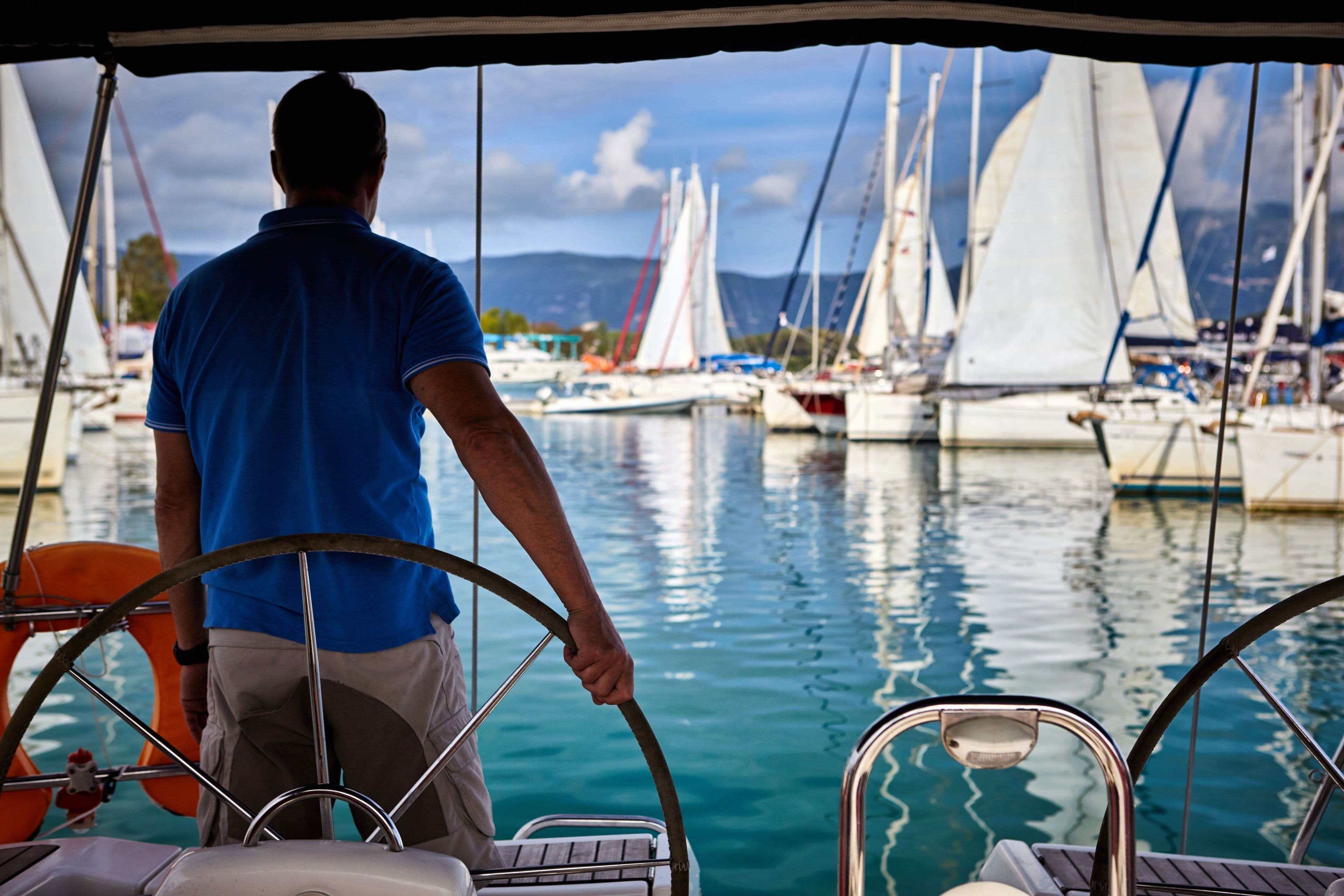
How to Med moor like a pro
Mooring in the Med is the bit of bareboat sailing that gives first-time skippers the cold sweats. Different procedure to home waters. Different crew jobs. Often a busy quay full of people watching. And the wind always seems to pipe up at exactly the wrong moment.
Good news: it's not as hard as it looks. The procedure is the same in every Greek, Italian, or Croatian harbour you'll sail into. Learn it once, you'll do it for the rest of your sailing life.
This guide covers what stern-to actually means, how lazy lines work, what to do differently on a catamaran, and the order things should happen in. If you've never done it, read it through once before your charter starts. If you've done it before, jump to the bit you need. These essential tips will help you glide from dock to taverna in no time.
What is stern-to mooring?
Stern-to means reversing your boat into the quay, dropping the anchor on the way in, and tying the back of the boat to a bollard or ring on the dock.
You end up with the bow pointing out to sea, the stern against the quay, and the anchor holding you off the dock. Step off the back of the boat onto land. Walk to the taverna. And relax.
Why backwards? Two reasons. Most boats have a swim platform or boarding ladder at the stern, so it's the easiest end to step off. And reversing in lets you drop the anchor as you go, which holds you off the quay securely.
What to know before you start
1. Your boat's prop walk.
When you reverse a single-engine monohull, the stern doesn't go straight back. The prop pushes it sideways; this is known as 'walking'.
Most boats 'walk' to port (left) in reverse; but not all of them.
On your first day, take the boat out into open water and reverse for thirty seconds. Watch which way the stern drifts. That's the direction you'll always need to compensate for.
Cats are different. Twin engines on a cat means no real prop walk. You can pivot on the spot by putting one engine in forward and one in reverse. That's an advantage in tight harbours, and we'll come back to it.
2. The Wind
Mediterranean harbours are sheltered, so the wind you feel inside the harbour can be lighter, gustier, or coming from a completely different direction than the wind outside the breakwater. Look at the flags on the quay. Look at how other moored boats are lying. Make a plan.
If the wind is blowing onto the quay (toward land), it'll push you in, which means you'll come in fast.
If it's blowing off the quay (toward open water), it'll push you off the quay. This is a little harder; you'll need more anchor chain and more throttle to hold position.
Crosswinds are the worst case. They push your bow sideways while you're trying to reverse straight. In a crosswind, you may need to drop anchor further upwind and to come in with more speed.
3. Know your chain
Know how much chain you've got. Most charter boats have 50 to 60 metres. You'll need roughly four times the water depth for the chain to hold properly.
So in 5 metres of water, drop 20 metres of chain. In 8 metres, drop 32.
Count the metres as the chain goes out. Most boats have markers every 10 metres — different colours, or paint stripes.
Ask at the charter base which is which. If you run out of chain halfway in, you can't moor. Reset and start again.
The full Med mooring procedure, in order
You're going to make seven moves. Brief the crew before any of them happen and make sure you have at least 3 fenders out on each side.
Two people on the bow (anchor and helm communication), one on each stern line, one on fenders if you've got the bodies for it.
Good communication and staying calm are key. There’s a lot happening, and if crew and skipper are focussed and relaxed, the process will run smoothly
The Approach
Step 1. Approach slowly, in forward, parallel to the quay. Pick your spot — the gap on the quay where you're going to end up. Approach from the side, in forward gear, at idle.
Move past your target spot so you can see how much room you have either side.
Step 2. Stop the boat alongside, four boat-lengths off the quay. Don't go in fast. Don't go in at all yet. Settle in neutral, four boat-lengths back from where you'll end up, ready to pivot.
Step 3. Pivot the bow around so the stern points at the gap. On a monohull: forward and turn the wheel hard to start the pivot, then neutral, then a short burst of reverse to bring the stern around. Use the prop walk to help you. On a cat: one engine forward, one in reverse. Pivot on the spot.
Step 4. Reverse toward the gap. Slowly. Idle in reverse. Walking pace, or as slowly as you can to hold your lane. The bow person stands ready at the windlass. The stern crew have the mooring lines ready, cleated to the boat with a bowline at the inside end and the free end coiled.
Use small bursts of forward to correct if the stern walks off course. Don't try to steer with the wheel until the boat has actually stopped moving. Turning the wheel mid-reverse usually just makes the boat fishtail.
I like to face aft throughout the reverse manouevre for optimal line of sight.
The Drop
Step 5. Drop the anchor at the right moment. About three to four boat-lengths from the quay, tell the bow person to drop the anchor. Don't shout — agree the signal beforehand. A hand drop or a clear "drop now" works. The anchor goes down. The chain pays out as you reverse. You should be reversing at about the same speed the chain is paying out — too fast and the chain piles up on top of the anchor; too slow and you're not setting it.
Watch the bow person counting markers. When you've got the right amount of chain out (4x depth), they snub it off on the windlass.
Step 6. Keep reversing until the stern is one metre off the quay. The chain snubs, the anchor sets, and you stop. You should now be sitting one boat-fender's-width from the quay, anchor holding you off. Stern crew step off the boat with the mooring lines (or pass them to whoever's on the quay to receive). Tie one to the bollard or ring on each side. Two lines forming a V back to the boat — same logic as a mooring ball bridle.
Step 7. Adjust. Once the lines are on, you can pull the boat closer to the quay by winching in the lines, or further off by pulling up chain. Settle the boat about half a metre off — close enough to step off, far enough that nothing's banging the quay. Engines off. Anchor windlass locked. Done.
Lazy lines: what they are and how to pick one up
In many Greek, Croatian, and Italian harbours or town quays, you don't drop your own anchor. The harbour provides a permanent ground line on the seabed, with a thinner line — the lazy line — running from it up to the quay. You pick up the lazy line, walk it to your bow, and tie it on. Your anchor stays put. Otherwise the manouevre is the same.
If you're picking up a lazy line and you're confident in your prop walk, you can approach it similar to reverse parellel parking a car.
Why lazy lines exist: in busy harbours, dozens of boats dropping anchors on top of each other ends in tangles. Permanent ground lines solve it. They're also faster to use once you know how. The lazy line is usually tied off to a small ring or chain on the quay. The harbour staff hand it to you, or you fish it out of the water yourself with a boathook.
Procedure:
- Reverse stern-to as above, but do not drop the anchor.
- As you approach the quay, the bow person stands ready.
- The stern crew tie the boat to the quay with mooring lines (the normal stern lines).
- The harbour staff (or you, with a boathook) grab the lazy line from the water near the quay.
- Walk it forward along the deck to the bow. The line is heavy, often slimy, and covered in barnacles. Wear gloves if you've got them.
- The bow person ties the lazy line to the bow cleat. Two cleats if it's a cat — one each side.
Tension it: pull the line tight so the boat is held forward, off the quay. Things to watch for with lazy lines:
- They go slack in the water. When you're walking it forward, expect dead weight and seaweed.
- The lazy line shouldn't rub against your bow roller or anchor fittings. If it is, ease the boat closer to the quay until the angle changes.
- In windy conditions, get the lazy line on fast. Without an anchor down, the lazy line is the only thing holding you off the quay, and a gust can push you sideways into the boat next door if you're not quick.
When it goes wrong: how to recover
Every Med skipper has a story. The recoveries below are the most common.
You're too far from the quay. You ran out of chain, or you stopped reverse too early. Don't try to bridge the gap with longer lines. Reset: motor forward, pull the anchor up, go round and try again.
Your anchor's fouled someone else's. Common every morning in busy Greek harbours. Lift slowly. If you've got another boat's chain tangled with yours, get a fender or a spare line under their chain and pass it back over your bow to lift it off. Don't yank.
The wind catches your bow as you reverse. Crosswind pushes your bow off-line. Use a bowthruster or burst of forward with the wheel turned to swing the bow back, then resume reverse. Going a little faster gives you more steerage, so sometimes adding a touch of throttle gives you more control in breeze.
Lazy line under your prop. Bad. If you reverse over your own lazy line and wrap it on the propeller, you'll need to dive on it or have it cut free. Prevent it: when picking up a lazy line, the helm goes to neutral the moment the bow person has it.
You're being shouted at by the harbour master. Listen. They've done this thousands of times. If they're telling you to come closer or further off, do what they say — they're seeing the angles you can't see from the helm.
Almost every problem can be overcome by communicating clearly, approaching slowly and starting again if it starts to go awry.
What to practise before you go
If this is your first Med charter, get two hours of stern-to practice in your home waters before you fly out. Most RYA Day Skipper schools and ASA 104 courses cover it. If yours didn't, book a refresher. Ask us if you need help with this.
If it's already your charter day and you haven't practised: ask your charter base for a briefing skipper for the first day. Most bases offer it for €180 to €250 a day. Worth every cent for one or two harbour entries with a pro at your shoulder.
Or just add a skipper to the whole charter for the first few days. Most Anchor sailors who do this say it's the best money they spent — you sail with the pro, learn the routine, then take over with more confidence next time.
A note on Stern-to Mooring
Anchoring The ability to anchor confidently is essential for Mediterranean cruising. Popular spots can become crowded, so it’s important to assess swing room and ensure you have enough space to avoid neighbouring yachts. Always check your depth and understand how your yacht will swing if the wind changes during the day.
Line Ashore In busier or more compact anchorages, tying a line ashore is an excellent option to avoid swinging and keep you in a fixed position. Be prepared to row, motor, or swim to shore to secure the line and tighten it. I have found that the easiest way to do this is to reverse close to the shore and send your shore line handler off with a floating line (if you have one). We usually use a paddleboard to get them ashore, but they can also swim or use the dinghy. Then, once they have secured the shore line (tied around a rock, not a tree!) and are paddling back towards you, begin to drop the anchor and gently reverse into your chosen spot.
I have always found this method works better than anchoring and then having to get someone ahore to haul the boat into position, especially in any breeze. Although if short-handed, you'll need to drop first, then get the line ashore.
Need some help?
If you are unsure about charter or boat selection, contact us at Anchor to help you decide.
We only choose boats that are in excellent condition, and we are here to help you every step of the way and to make sure the whole process is as easy as possible.